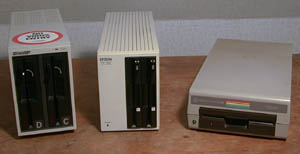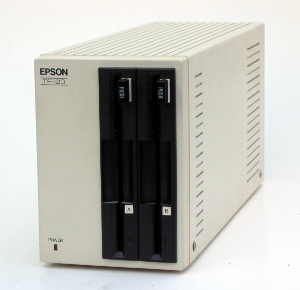
The TF-20 is a peculiar device in that it contains a complete computer system that boots from the disk. It is Z80 based, has 64 kByte RAM (not a trival amount in 1982!), a boot PROM, serial interface and floppy controller (µPD765A). Once the OS, 'TFDOS' is loaded, it can communicate to external devices like the HX-20 or PX-8. There is no console connection to check booting has succeeded, but if the drive A is repeatedly accessed, assume booting has failed. A succesful boot accesses the disk exactly three times, where there is a short pause between the first and second time. Hard to explain in words, so I made a movie.
The TF-15 looks very similar, but has less RAM (2 kByte) and the OS in ROM (8 kByte). Only the PX-4 and PX-8 commands are supported, not the HX-20 commands. (TSD881a)
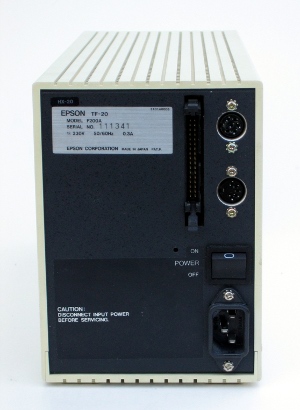
Some specs:
Serial interface baud rate: 38400 bd
40 track double density, 16 sectors of 256 bytes per track/side. The disk geometry is identical to that of the QX-10, so the first four tracks are reserved for CP/M CCP, BDOS and a large BIOS. Track 4 is the directory and track 39 is not used. This leaves 278 kByte per disk for use data. A system disk, containing BOOT80.SYS (TF-20 boot file, also referred to as TFDOS) and DBASIC.SYS (HX-20 Disk basic extension) has about 8 kByte less space.
An image is available.
The manual and schema are available from the documentation directory
to
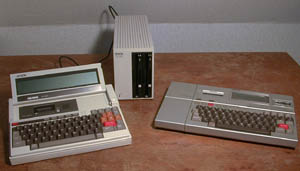
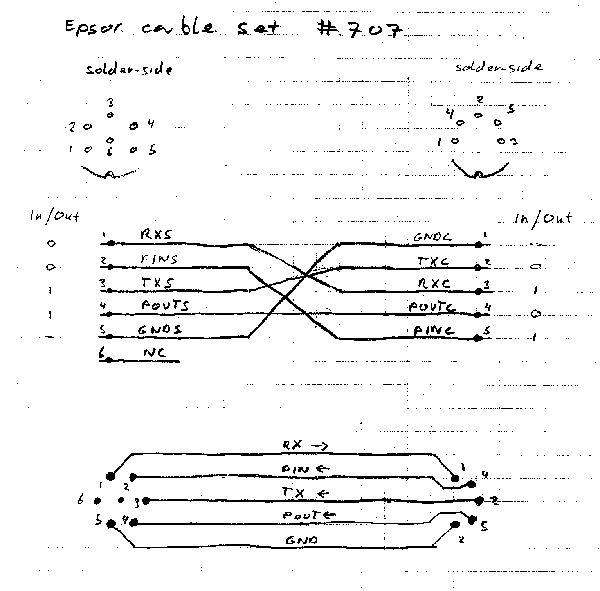
For connection with the HX20 you need Cable #707. For the PX-8 use cable #723.
devices